As an English teacher, I often have students create dramatic skits on given themes. And often when I read them students occasionally write in their classmates’ names instead of the fictional characters they made up. Once, a student wrote “Mr. Chimski” for “Mr. Chimsee,” an evil prison warden! The rub is understandable: if you are creating characters based on real persons, the mixup seems inevitable in the heat of creation.
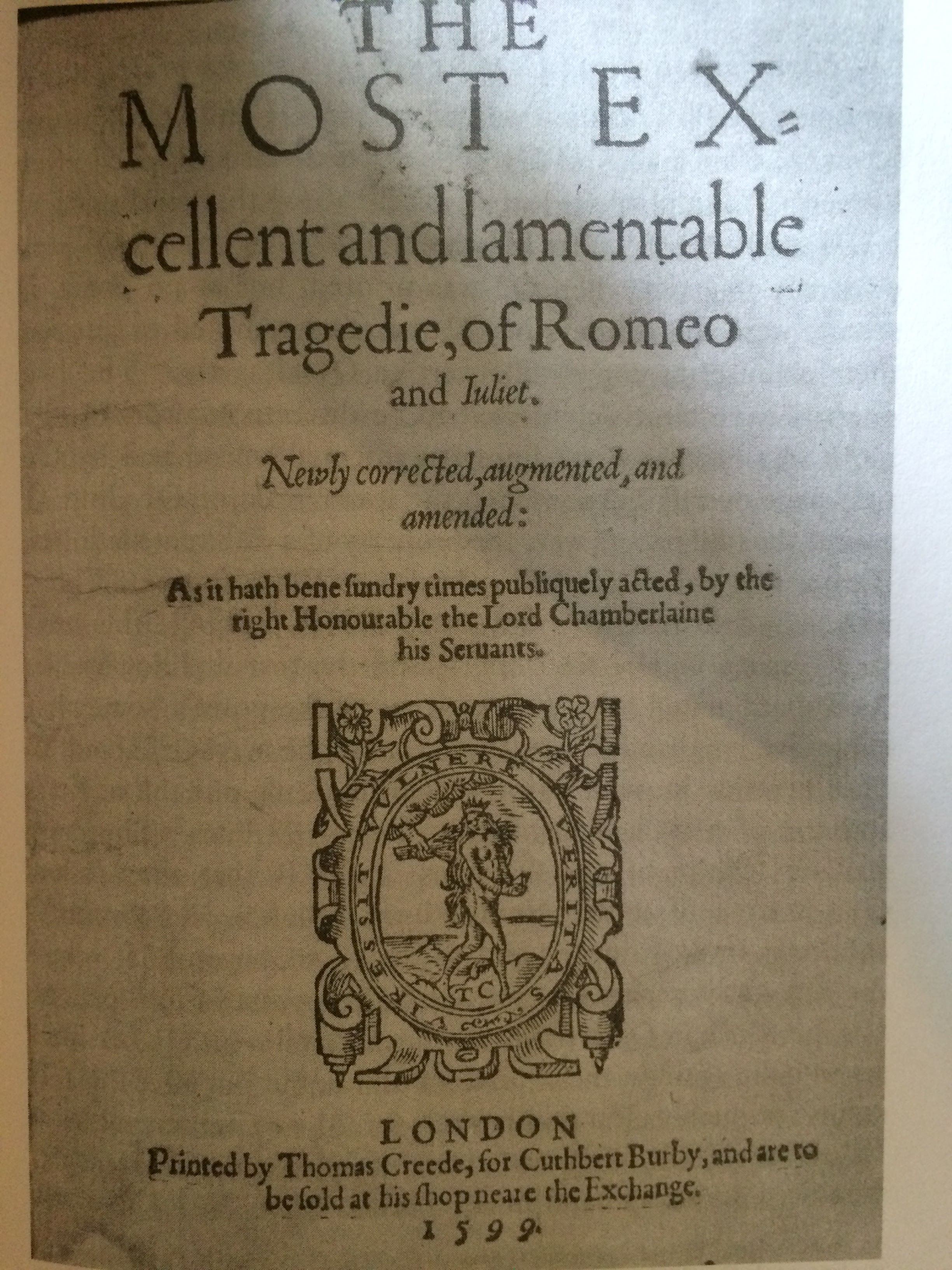
One hard evidence we have for Shakespeare’s authorship can be found in the 1599 edition (the second quarto) of Romeo and Juliet, where at the end of scene 17 a stage direction instructs “Enter Will Kempe.” Kemp is not a character in the play, but a real person for whom Shakespeare wrote the part of Peter the Clown. Shakespeare mixed up the character with the real person.
How this points to Shakespeare’s authorship I will return to in a moment. First, a few things about Kemp. He was part of Shakespeare’s acting company, and a famous one at that. Being so, we know that Shakespeare had created other comic characters for him to play well before Romeo and Juliet. He was considered a celebrity comedian of his time, given to improv, one whose acting persona was indistinguishable from his personality. He seemed to play himself.
Thus, in the heat of creation, it is easy to perceive how Shakespeare sometimes mixed up Kemp’s name with the characters Kemp played. The mix up also happens in the quarto edition of Much Ado About Nothing. In place of the comic characters Dogberry and Verges, the text reads Kemp and Richard Cowley, another player in Shakespeare’s acting company.
These facts points to Shakespeare’s authorship because no other playwright in Kemp’s tenure with Shakespeare’s acting company could claim to have had the working relationship between actor and playwright that Shakespeare had with Kemp (and indeed with other fellow actors). Not one of the many candidates that Shakespeare deniers claim to be the real writer of the plays—not the Earl of Oxford nor Francis Bacon nor Christopher Marlowe—could claim to have had such an intimate working relationship with Kemp as Shakespeare did. Therefore, not one of the deniers’ candidates could have been liable to the mistake of mixing up actors’ names with characters. No wonder Shakespeare deniers ignore this evidence.
About the Hard Evidence Series
Did Shakespeare write Shakespeare? Of course he did. The scholarly consensus on it mirrors the consensus on climate change. But if you are part of a literary community—as an academic, a teacher, a student, a reader, a bookshop clerk —one encounters deniers. As someone who has rounded all these circles, I myself have encountered them often. And if you are not prepared, they can easily make you look like a fool for assuming Shakespeare’s authorship. A student of mine did it to me once. And, to be frank, it was traumatizing, being caught unaware, the quality of the embarrassment, the sophistic acrobatics I had to perform in order to discredit the denier and save face before my students. At any rate, readiness is all. No teacher should be reduced to sophistry defending the truth of Shakespeare authorship no more than climate change. This blog series, Hard Evidence, is part of the resistance against the deniers. It presents and explains the facts of Shakespeare’s authorship, written for the great variety of readers.
SOURCES
Shakespeare Beyond Doubt: Evidence, Argument, Controversy (2013) edited by Paul Edmonson and Stanley Wells, Cambridge University Press
Contested Will: Who Wrote Shakespeare? (2010) by James Shapiro, Simon & Schuster
For digital copies of the second quarto of Romeo and Juliet and Much Ado About Nothing, see the British Library website: bl.uk/treasures/shakespeare/homepage.htm
SUGGESTED FURTHER READING
The Professions of Dramatist and Player in Shakespeare’s Time, 1590-1642 (1984) by Gerald Eades Bentley, Princeton University Press
Shakespeare: His Life, His Language, His Theatre (1990) by S. Schoenbaum, Penguin Group
 chimski
You must be logged in to post a comment.