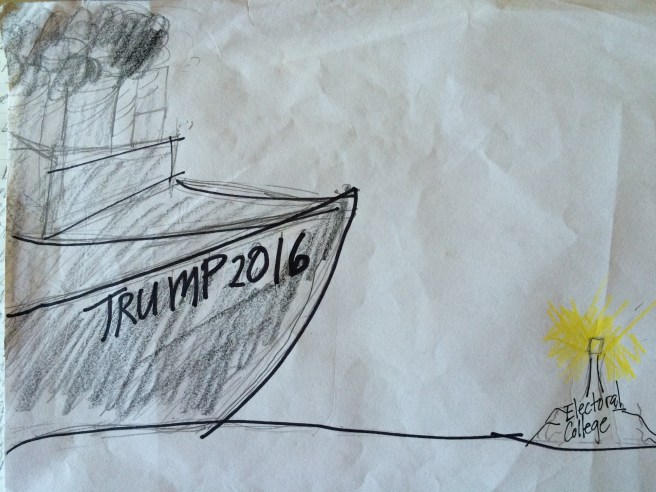
Many Americans will move to Canada if it happens. The BBC reported in March that it is the top threat to the global economy and US national security. It will do a lot wrong to mother nature and to the female gender writ large. We do not even want to imagine the insult and injury it has in store for the minority populations. On the other hand, after eight years of drought under President Cool, it gives comedians cause for optimism about the future of joke material harvests. It is a Trump presidency, and it has the world on red hot alert.
After New York’s primary this past Tuesday, the red should have gotten redder because Trump has “mathematically eliminated”—to use the phrase in his victory speech—his Republican rivals for the party’s nomination.
Every poll out there forecasts dismal weather for the Republican presidential runner in the general election this fall. But the GOP have a lot of tricks up their sleeves, from anti-voting laws to unprecedented campaign finance resources. In other words, the chances of a Trump presidency is very real, and we Americans would do well to prepare. Trump could end up seducing and winning the popular vote.
There is hope, a last resort we suggest, in the form of the Electoral College, which could legally overturn the popular vote.
The Electoral College formally votes the president into office rather than the ballots on which people cast their vote. It is made of 538 “electors” from each state apportioned by each state’s share of elected representatives in its congressional delegation.
If you watch enough of Real Time with Bill Maher, you will catch him put down the Electoral College or advocate for its abolition, saying that it is pointless, a parental insult to the popular will. He has a point: it does not seem fair that 538 electors could invalidate the majority popular vote.
The Founding Father James Madison would have disagreed with Bill Maher. In the debates of how the US Constitution was to be, Madison argued against giving power to the people. He said in 1787 that the “equality of universality of suffrage” was a “danger.” (I am not judging Madison here; he had valid reasons and good arguments for his view. And we must remember he lived in the times when the French Revolution, a populist revolt, became the Times of Terror, giving populism a bad face that scared the aristocratic intellectuals all over the world, including Madison.) The influence of Madison’s position runs deep in the US Constitution. And an outcome of his influence is the Electoral College.
The Process that allows the College to overturn the popular vote goes by another name: checks and balances. It is meant to prevent a branch of government from having too much power, in the way the executive, legislative, and judicial branches are supposed to check and balance each other’s powers. It is generally spoken of in a positive light.
And now, with a popular vote poised to elect Trump, the Electoral College, usually spoken of in a negative light, could be our last beacon of hope, for what would be a Titanic presidency.
FURTHER READING
The Debates in the Several State Conventions: On the Adoption of the Federal Constitution, as Recommended by the General Convention at Philadelphia, 1787 (1907) edited by Jonathan Elliot in 4 handsome volumes, J. B. Lippincott Company
 chimski
You must be logged in to post a comment.