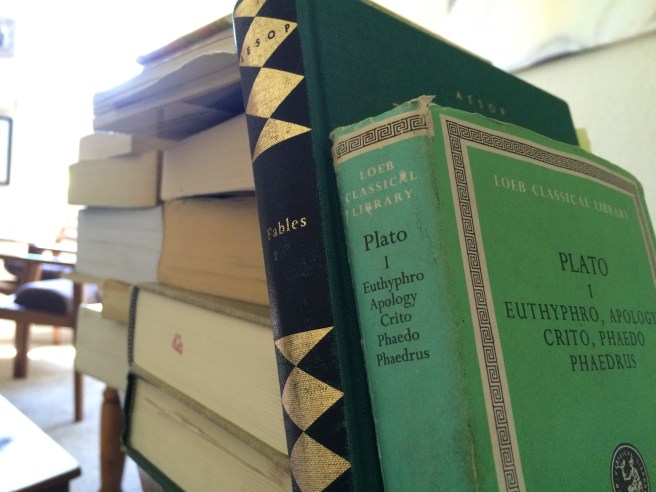
If there is anything anyone knows about Socrates, besides being the great midwife of Western Philosophy, it is that he wrote nothing. I heard it from all of my philosophy teachers and read it in just as many books. “Socrates wrote nothing,” Princeton professor Melissa Lane writes in her exemplary study, Plato’s Progeny: How Plato and Socrates Still Captivate the Modern Mind. “A man who confined himself to oral discussion,” writes Bertrand Russell in his marvelous The History of Western Philosophy. In the best complete works of Plato in English (which I quote throughout this article), its editor John M. Cooper writes in his introduction, “Socrates himself, of course, was not a writer at all.” There are countless others:
“Socrates wrote nothing himself” (W. K. C. Guthrie in his introduction to his translations of Plato’s Protagoras and Meno)
Socrates “wrote nothing” (Penguin’s edition of The Laws)
Socrates was “enigmatic because he wrote nothing himself” (The Oxford Guide to Philosophy)
“Although [Socrates] himself wrote nothing…” (The Cambridge Dictionary Dictionary of Philosophy)
There are several more I could quote from my library alone, saying more or less the same thing. I have read it so many times I do not even bother to question it. In this piece, I do just that, with surprising results and rich suggestion, throwing new light on the dogma that the historical Socrates wrote nothing. Continue reading
 chimski
You must be logged in to post a comment.